
AUGUST 24, 2026
How to Pay Your Bills With Crypto in Nigeria: A Practical Guide
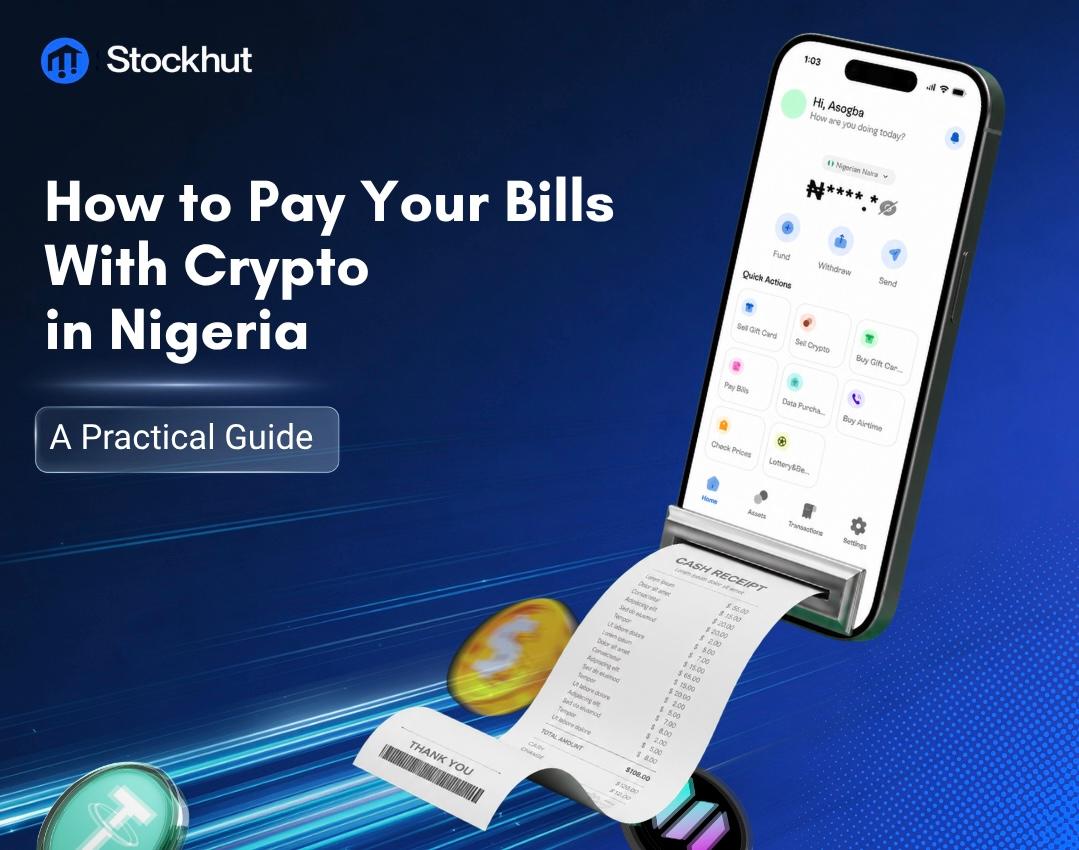
Most Nigerians who earn in crypto spend most of their time thinking about how to convert it to naira. This is understandable. Your day-to-day needs require Naira. Landlords, Bukkas, Danfo, market vendors, and every physical service in this country accepts payment mostly in fiat. But for a growing number of digital expenses, the conversion step is becoming unnecessary. You can pay those bills directly with the digital balance you already have, and this guide explains exactly how.
Why Paying Bills With Crypto Is Becoming Practical in Nigeria
The rise of integrated financial platforms has made it possible to manage multiple financial actions from a single balance. If you hold USDT or receive naira from a crypto conversion, you no longer need to send that money to a separate bank account and then open a different app to pay each bill.
The categories of bills that can now be paid through integrated platforms like Stockhut include electricity tokens, DSTV and cable subscriptions, mobile airtime across all networks, data bundles for every major Nigerian network, and some categories of government fees. The range is expanding as the infrastructure matures.
The Time and Money Cost of Fragmented Bill Payment
The hidden cost of managing your bills across multiple platforms is not always visible on a spreadsheet, but it is real.
Consider a month in which you pay your electricity token through one app, your DSTV through another, your data through your network's USSD code, and your airtime through a third platform. Each of these has its own login, its own interface, its own potential for downtime. Every instance of an app not loading, a transfer failing, or a subscription processing slowly is time and stress that compounds across twelve months.
Beyond the friction, some of these platforms charge convenience fees that do not appear in the headline price. Paying 100 naira more per electricity token because the app adds a convenience fee does not feel significant in a single transaction. Across twelve months of monthly recharges, it adds up to money you did not need to spend.
How to Pay Bills Through Stockhut
The process is straightforward and the same logic applies regardless of which bill you are paying.
● Step one: Ensure your Stockhut balance is funded. You can do this by converting gift cards or crypto to naira within the app, or by funding your account directly. The naira balance becomes available immediately after conversion.
● Step two: Navigate to the bills payment section. Select the category that matches what you are paying — electricity, cable, airtime, or data.
● Step three: Enter the relevant details. For electricity, this is your meter number. For DSTV, your smart card number. For airtime and data, the phone number you are topping up. The platform validates these details before processing, which reduces the risk of paying the wrong account.
● Step four: Confirm the amount and complete the payment. The transaction processes immediately during standard hours. Your token, subscription renewal, or airtime arrives within minutes.
The Advantage of One Balance for Everything
The practical benefit of using one platform for both crypto conversion and bill payment is the elimination of the middle step. You convert your USDT to naira and immediately allocate it to the bill that needs paying, without moving money between apps or waiting for a bank transfer to settle.
For freelancers and remote workers who receive income in USDT, this creates a complete financial cycle within a single platform: client sends USDT, you convert at the live rate, you pay your electricity and DSTV and data for the month, and the remaining naira sits in your balance ready for withdrawal. No bank transfer needed at any intermediate step.
Bills You Cannot Yet Pay With Crypto Directly
Rent, physical market purchases, and services from vendors who only accept cash still require naira in your bank account. No digital platform in Nigeria has bridged that gap entirely. The practical approach for now is to handle your digital bills through an integrated platform and reserve your bank account withdrawals for physical cash needs.
School fees for institutions that have implemented digital payment portals can in some cases be handled through transfer, though this depends entirely on the institution's payment infrastructure.
The direction of Nigerian financial infrastructure is toward consolidation. The era of maintaining six payment apps for six different bills belongs to a period that is already ending. The platforms built to replace it are the ones that handle the widest range of financial actions from a single user experience.
Stockhut's bills payment feature exists within this trajectory. Convert your crypto. Pay your bills. Keep the rest. All from one place.
Pay your electricity, data, DSTV, and airtime on Stockhut — the same app where you convert your gift cards and crypto. Download free today.
More Stories
AUGUST 22, 2026
Have you sent crypto before? Or received it. And somewhere in that process, someone said the word wallet and you nodded along while quietly having no idea what that word meant in this context.
AUGUST 10, 2026
The Nigerian crypto platform market in 2026 is more crowded than it has ever been. Cardtonic, Quidax, Prestmit, Ricki, GCBuying, Monica, and several international platforms all compete for the same base of Nigerian users.
JULY 31, 2026
This write up explains the concept ERC20?, TRC20?, USDC & USDT.
JULY 09, 2026
Chances are, you have come across a lot of crypto and blockchain terms and it seems unending, in this post you will learn essential crypto terms you should know